
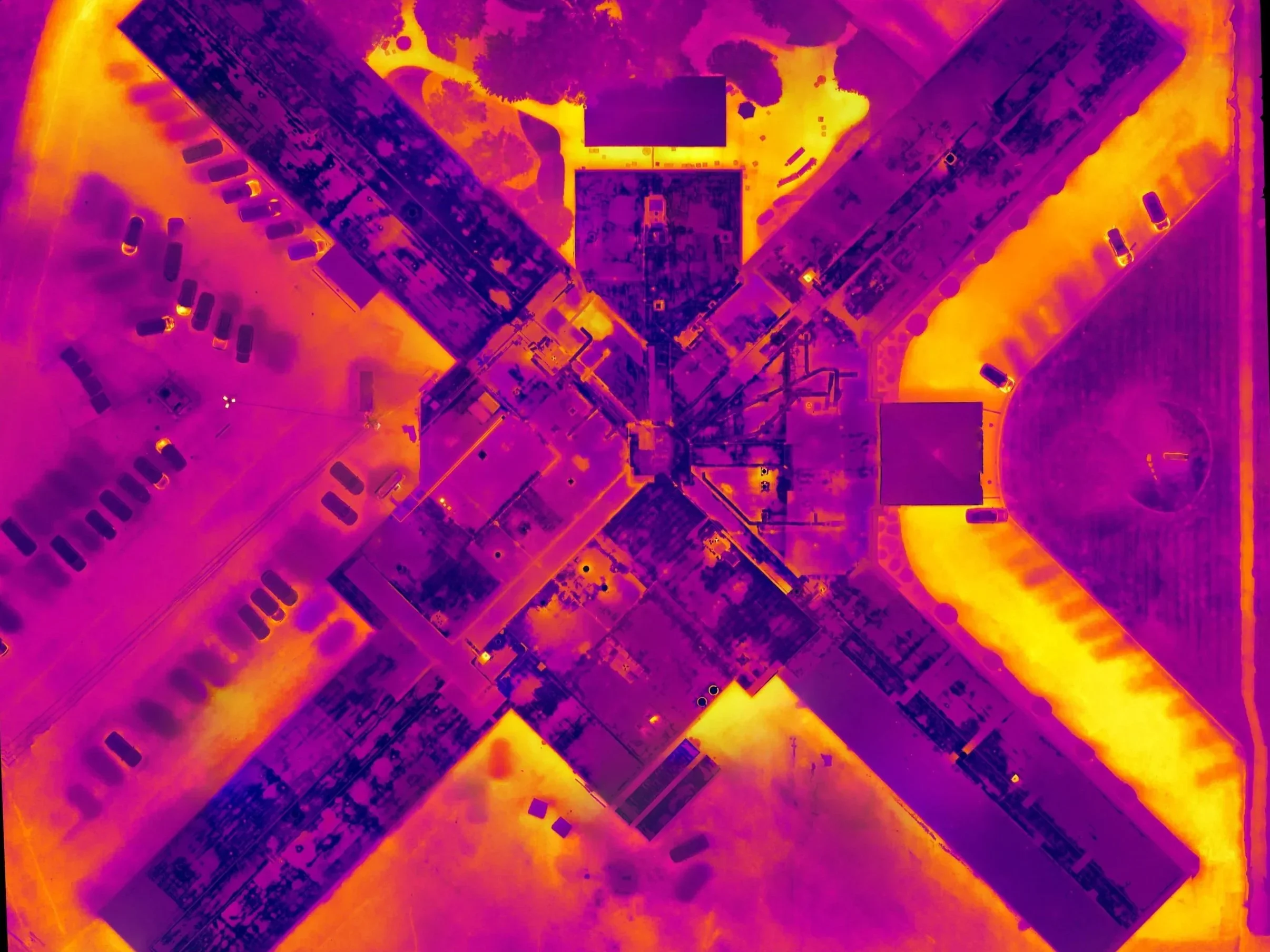
FAA PART 107 LICENSED · DRONE THERMAL ROOF SCANS
See where a roof is wet before anyone cuts into it
Our drone thermal inspections show exactly where moisture is hiding under a commercial roof, then verify the real trouble spots on the ground so you are not guessing. No one walks the membrane to find the problem, and you get an honest, third-party report of what is actually going on up there.
-
FAA Part 107
Licensed Drone Pilot
-
$2M Insured
General liability
-
Verification + Core Cuts
We confirm the findings
-
Nationwide
Coverage
HOW IT WORKS
Why a thermal camera can see what your eyes can't
A thermal camera does not see water directly. It reads surface temperature. In daylight a wet roof and a dry roof look the same, so we fly at dusk after a sunny day. The dry roof gives up the day's heat quickly, but the wet insulation underneath holds that heat longer and shows up warm against the cooler areas around it. That is the window where moisture is easiest to spot, and it tells us not just that the roof is wet, but how far the problem has spread.
It is non-invasive. We map the whole roof from the air in one visit, so no one is walking the membrane or cutting test holes just to find out where to look.
A warm spot isn't always a leak
Here is the part most thermal companies skip. A warm area on the scan is a strong signal, but it is not proof on its own. Sometimes that heat is an HVAC unit, ponding water on the surface, or debris holding warmth. Calling every warm spot “moisture” is how owners end up paying to tear off roof that was actually fine.
So we do two things differently. We read the scan carefully and tell you what we are confident about and what needs a closer look. And for the spots that matter, we verify them on the ground before anyone commits to a scope.
BEYOND THE SCAN
We don't just spot it. We confirm it.
Thermal tells you where to look. Verification tells you what is really there. We can take the next step on the roof and confirm the findings before you build a scope or a bid around them.
On-roof verification scan
A follow-up walk of the flagged areas with a handheld thermal and moisture meter, confirming the drone findings spot by spot. This rules out the false positives, the HVAC warmth, the ponding, the debris, so the map you act on is the real one.
Core cuts
For warranty work and final confirmation, we can pull core samples at the flagged locations to see the actual condition of the insulation and deck, then patch the cut properly. This is the level of proof manufacturers and owners trust for a restoration-versus-replacement decision.
One report, both passes
The verification findings fold back into one clean report. You get the wide thermal picture and the confirmed ground truth in the same document, so there is no gap between what the scan suggested and what is actually wet.
HOW TO BUY IT
Start cheap and wide. Verify only what matters.
You do not have to buy the whole thing at once. Most jobs work best in two touches.
First touch — Drone thermal scan
A fast, lower-cost scan that covers the entire roof and flags every anomaly. This alone is often enough to bid the real scope, plan core sampling, or decide a roof is fine and does not need work yet
Second touch — Verification pass
A verification pass on the flagged areas, with core cuts where the job warrants it, before anyone signs off on a tear-off or a restoration. The money only gets spent confirming the spots that drive the decision.
What you receive
In every report
- ✓Full-roof drone overview photos
- ✓Thermal map of the roof with anomalies marked
- ✓Side-by-side thermal and visual frames
- ✓Plain-language notes on what is confident vs. needs verification
- ✓A clean, branded PDF you can forward with a proposal
Add when the job calls for it
- +On-roof verification scan of flagged areas
- +Core cut samples with proper patching
- +Restoration-versus-replacement summary
- +Repeat-visit documentation for warranty/insurance
- +Drone marketing photos/video while on site
WHO WE WORK WITH
Built for the people who own, manage, and fix commercial roofs
Building owners & facilities
Find out what is really happening on your roof before you spend on it. An honest, third-party report tells you whether you are looking at a repair, a restoration, or a replacement, backed by data you can trust.
Roofing contractors
Bring us in or refer us. Bid the real scope, only tear off what is actually wet, and hand the owner an unbiased report that backs your recommendation.
Roofing consultants
An extra set of eyes and a thermal deliverable you can put your name on for owners and specs. We stay in the capture-and-verify lane and let you own the relationship.
Manufacturers & reps
Independent thermal that quantifies how much of a roof is wet, which is exactly the data a restoration-versus-replacement conversation needs early in the sale.
How Our Process Works
Tell us the building
Send the address, or just the city and roof size if it is confidential. We usually ask for about a week's notice to get scheduled.
We fly the scan
We fly the roof at dusk after a sunny day for the best thermal contrast, and capture full drone photos of the whole roof in the same visit.
We verify what matters
For the flagged areas that drive the decision, we come back for an on-roof verification pass and core cuts where the job warrants it.
You get the report
You receive the full PDF: the thermal findings, the verification results, and the photos, ready to put in front of an owner.
The same roof, two ways
Visual / RGB
Real drone photo of the roof. Looks fine from the air.
Thermal
Same roof, thermal scan. The warm zone is moisture holding heat under the membrane.
On the left, the roof looks fine from the air. On the right, the thermal scan shows a warm zone holding moisture under the membrane, measured well above the surrounding area. Confirmed on the ground with a core cut. That is the difference between a guess and a finding.
Frequently Asked Questions
-
Because a thermal camera reads temperature, not water. During the day the sun heats everything evenly and wet and dry roof look the same. After a sunny day, as the roof cools at dusk, the wet areas hold heat longer and stand out. That short window is when moisture is easiest to find.
-
Not by itself. It is a strong signal, but heat can also come from an HVAC unit, ponding water, or debris. That is exactly why we offer secondary verification. We confirm the flagged areas on the ground, with core cuts where it matters, so you are acting on facts and not a false positive.
-
We are based in Southwest Michigan and provide drone thermal roof inspections nationwide. We travel for the right projects and work through travel cost on a job-by-job basis.
-
Yes. We hold an FAA Part 107 Remote Pilot certificate and carry $2 million in commercial general liability insurance. We can provide a certificate of insurance if your owner or GC requires one. We are also a member of the Chicago Roofing Contractors Association.
Request A Quote
Tell us about your project and hear back within the hour.